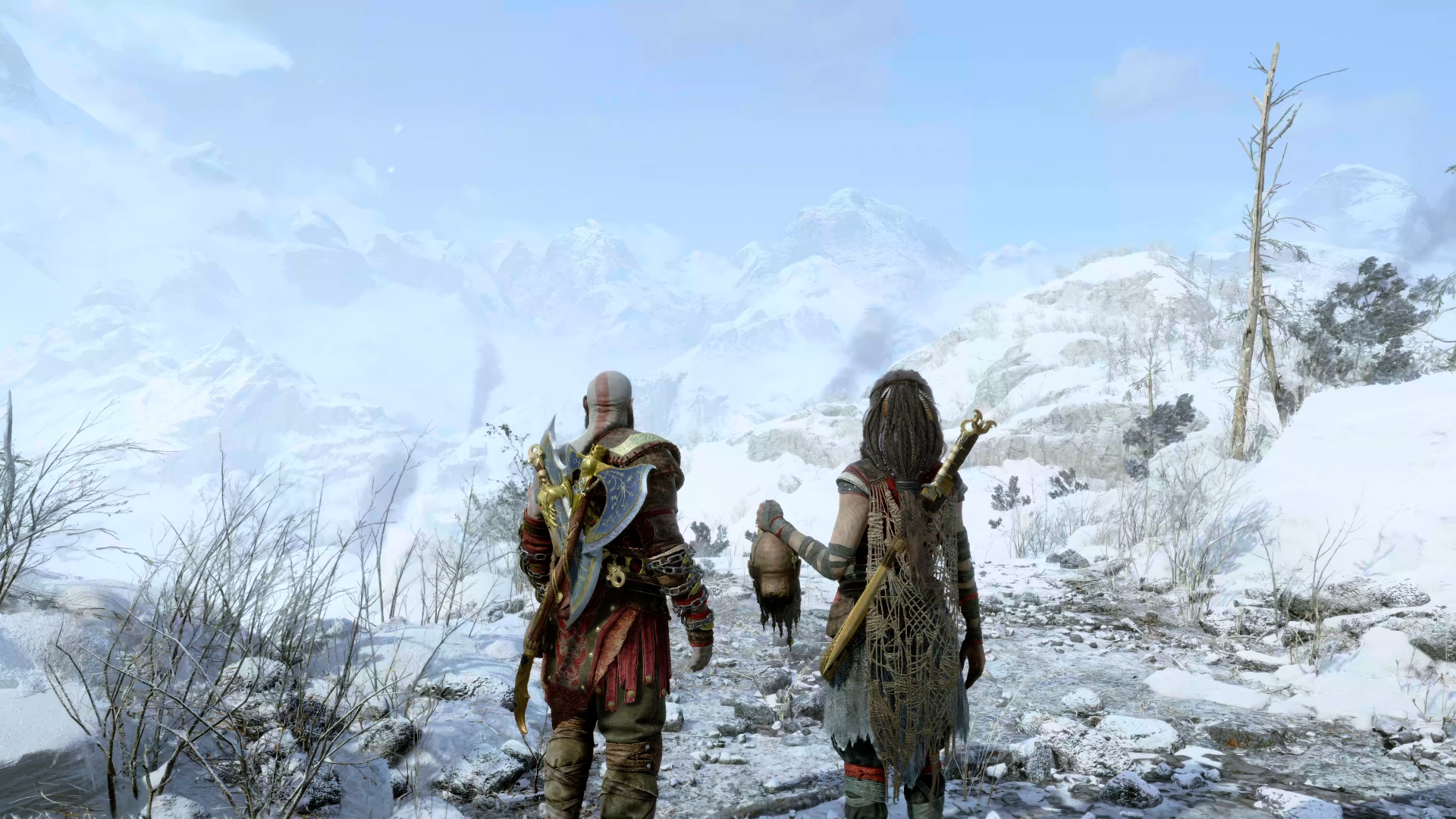
I Played God of War: Ragnarök Wrong (and you probably did too) – An Essay
I have beef with God of War: Ragnarök. I've been a fan of God of War for over 15 years, from way back when I sat in one of those curved GAMER chairs in a Best Buy and ripped Helios' head off in a demo for God of War III. I christened my seventeenth birthday by marching into a GameStop and purchasing three God of War games (and Animal Crossing: City Folk). I have an entire season of Chapter Select dedicated to the series.

So when I earned the Platinum trophy and wrapped up Ragnarök in December of '22, I was bummed to realize I had a major issue with the Norse "conclusion." Sure, the combat is crispy, crunchy; the acting is superb across the board—I'm a big fan of Toby's new role in this Norse administration—and I loved any part where I wasn't playing as Atreus. It was an absolute travesty of the mythical power fantasy to not let us wield Mjölnir, but that transgression is not the crux of my problem with Sony Santa Monica's PS5 debut.
My issue is that Kratos kept saying one thing, but doing another.
The whoooooooole game, Kratos is saying he doesn't want to kill the gods, that he doesn't want to lead. Kratos just wants to hide out and keep Atreus safe (frankly just like God of War in 2018). What Kratos does though is, well...wipe out most of the Norse pantheon and its creatures, and trigger the apocalyptic event known as Ragnarök.
Kratos is a hypocrite.
And that irked me.
The only time Kratos' words and actions line up with my desires as the player is at the end of the game when he realizes he can be a good god and serve the realms. He sets out with Freya and Mimir to bring peace to all nine of 'em. Except, when that alignment occurs, I had already completed most of the side quests that the realms had to offer. There was nothing left for Kratos to really do.
I replayed Ragnarök in early 2025 and decided to conduct a little experiment—I was going to skip all* the side quests and save them for the endgame.
Before I share how my little 25-hour experiment went, I want to share why Kratos is out of alignment with the player, A.K.A you and me. It comes down to the choices Kratos makes under pressure, revealing his true character, which according to Robert McKee in Story: Substance, Structure, Style and the Principles of Screenwriting is "revealed in the choices a human being makes under pressure—the greater the pressure, the deeper the revelation, the truer the choice to the character’s essential nature...The only way to know the truth is to witness him make choices under pressure to take one action or another in pursuit of his desire. As he chooses, he is."
That idea—"As he chooses, he is,"—has haunted Kratos, both inside his games and out here in the real world at large, for the last 20 years. I think it has loomed over Sony Santa Monica for those decades as well. They are the God of War studio despite any previous efforts.
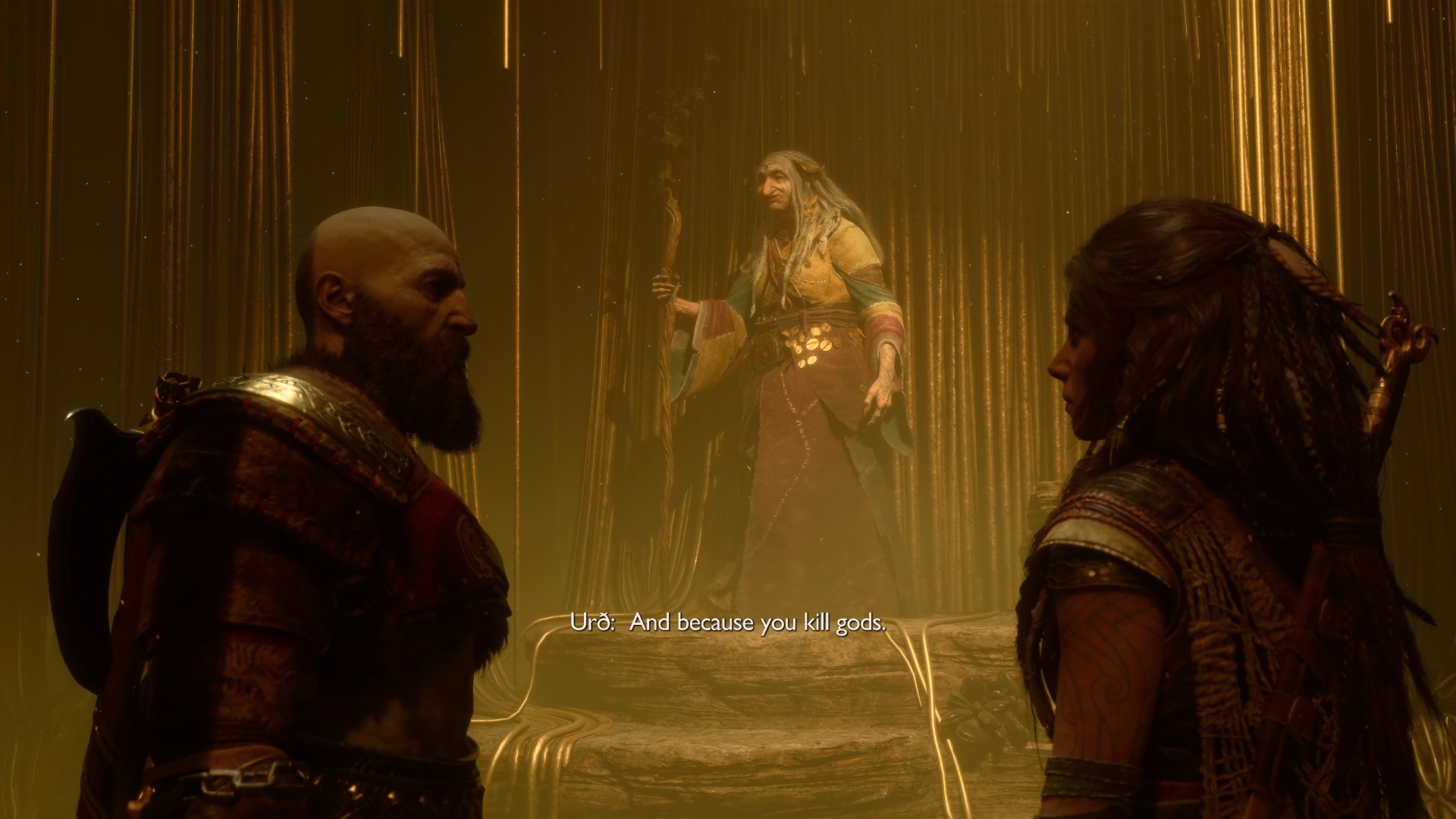 Urð: And because you kill gods.
I think it is safe to say that the team wanted to try and change Kratos' true character. They did a remarkable job in 2018, but Ragnarök felt like a regression. Under the chill of Fimbulwinter, Kratos hides away inside himself, despite him saying otherwise.
"We do not hide...We prepare for a fight for which we are not ready."
He professes change with his mouth, but when push comes to shove—when the pressure mounts—Kratos makes the same choice he always has. He talks like Odin's war-fearing rendition of Tyr, but acts like the Ghost of Sparta.
Sure, Kratos has a justification for all this.
"I kill to protect my son. To aid my friends. But I will be no one's monster. Never again."
He's not squeamish about killing. His reasoning is righteous, perhaps even noble. Kratos is just using his skills as a reactionary protagonist, while I'm behind the controller being proactive.
There's no better self-contained example than the Heimdall encounter. You, Sony Santa Monica, the story's merry band of misfits, and I all know that Heimdall's death kicks off Ragnarök. It's a fated event, not only in this rendition of Norse myth, but within the expectations of a God of War game. It's semi-sorta-kinda like the anticipation of fighting Thor, especially after the game-long-tease that was 2018. It's the perfect recipe. You have a cocky, smug son of a gun primed for the god-killing machine. Ever since our little detour with Atreus earlier (where he would not shut up as he climbed a wall), we have been keyed up to throttle this purple-eyed punk. Kratos isn't ready, but we are.
This use of dramatic irony further divides the player and Kratos. Of course, that does not stop Kratos and the player from preparing the way by getting the Draupnir Spear. While Kratos may not want to fight, he is always prepared to fight (We do not hide...We prepare for a fight for which we are not ready...). We finally encounter Heimdall and the gloves come off. Before we tussle with the golden lad, Freya says out loud what we are all thinking:
"I know you didn't want this, but we know how this ends."
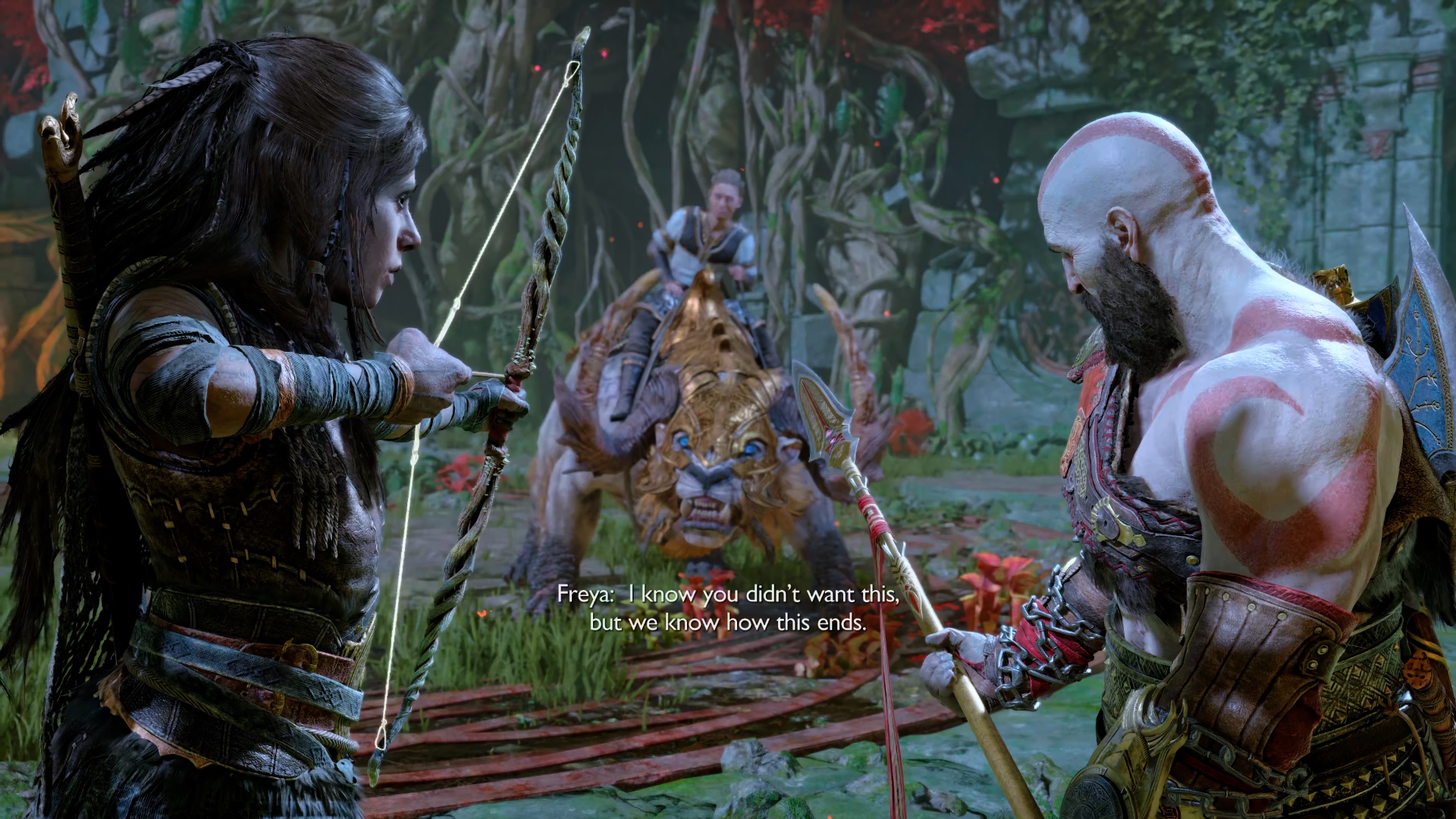 Freya: I know you didn't want this, but we know how this ends.
But this is only half true. Kratos may not want the fight with Heimdall, but I do. I want this fight because of the promise of mythical, action-driven combat the series is lauded for. It's a well-designed fight too, with good phases, patterns, and it's almost all spear. This is the cornerstone gameplay that built Sony Santa Monica's house.
Before we reach the final act of the fight, Kratos does offer Heimdall (and himself) a way out. Divine pride gets the better of our Norse foe and he summons a barrage of Bifröst attacks. It doesn't take long for Kratos to get a hold of blondie and as he chooses, Kratos is.
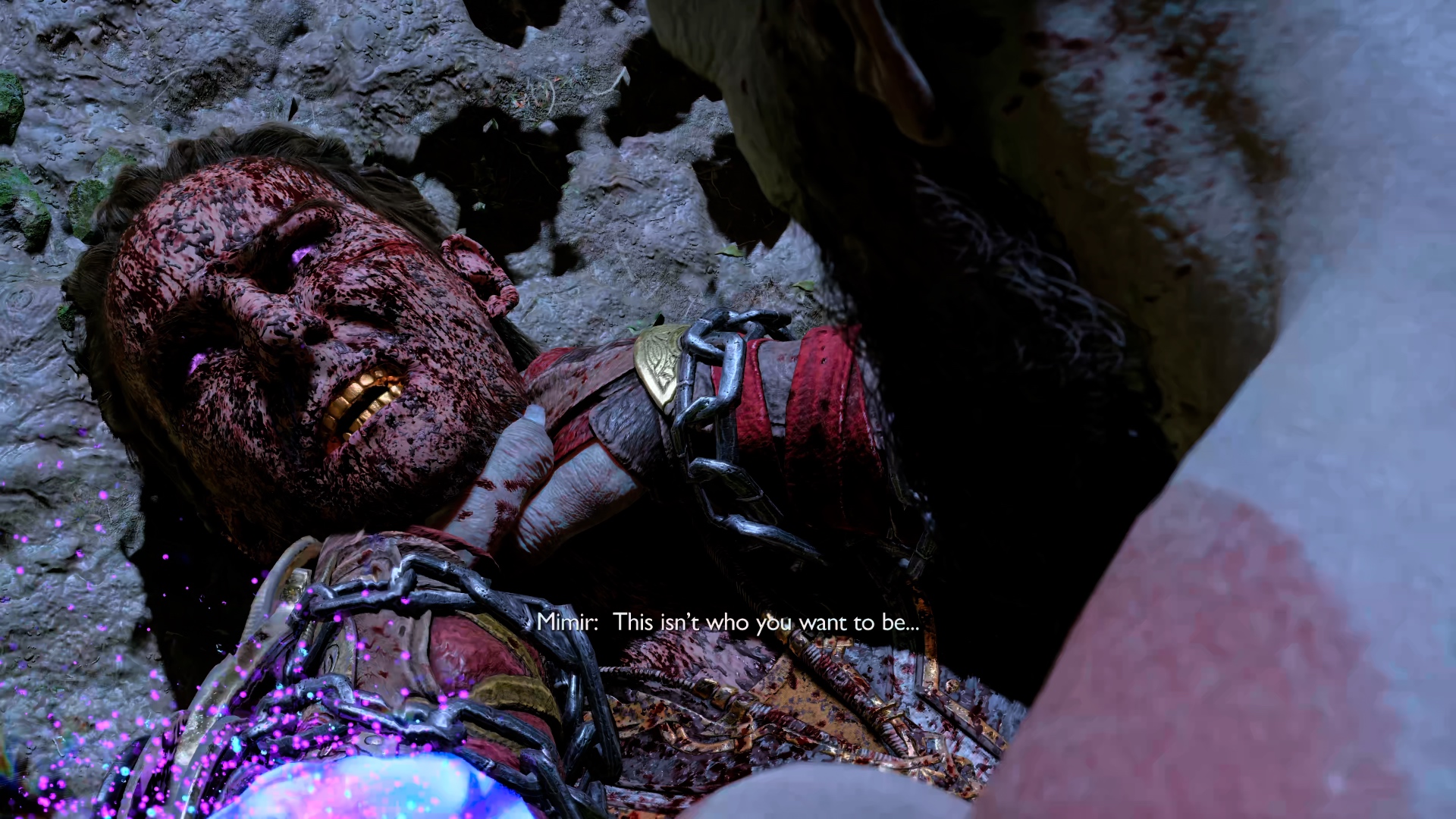 Mimir: This isn't who you want to be...
But "Max!" you say, "Sony Santa Monica did that misalignment on purpose, to give Kratos an arc. Duh." I agree with you. So does Robert McKee:
"Taking the principle further yet: The finest writing not only reveals true character, but arcs or changes that inner nature, for better or worse, over the course of the telling."
But me—the player—my "true character," my goals, don't change at all. From first boot to freeing up my SSD, I wanna swing an axe, kill trolls, fight Thor, etc. etc. etc. I wanna romp around with Kratos' virtual son. I wanna hear stories from Mimir and check off boxes/side quests to earn trophies. I wanna experience a riveting tale. I want to be the God of War.
This means my journey—my arc—remains static while I wait for Kratos to get on board. I'm not saying that Sony Santa Monica needs to kowtow to the whims of players. I love when devs subvert my expectations and take me on the journey they want to tell. But the team over-indexed on a passive, defensive, talking Kratos.
Amazingly though, Santa Monica did build an option into the game where we, the player, can be in alignment with Kratos. We just have to skip all the extras until credits roll.
When Atreus goes off to college and Kratos stumbles across his own secret Giant prophecy, he realizes what his second wife saw in him—the potential to be a good god and serve the realms—to serve the people. The side quests and post-game content are how we do that through the controller, or as Naughty Dog likes to say, "on the stick."
Kratos goes from reluctance and the understandably selfish desire to spend as much time with his son as possible to a willing, helpful, and caring servant of the realms. With Freya at his side, they both reflect, grow, and bond in this new, shared purpose. And, of course, we help everyone by swinging an axe, some blades, and throwing infinite spears.
When I replayed the game in the spring of 2025, I played on New Game+ and wanted to mainline it. I needed to capture certain scenes and really wanted to get to the Valhalla DLC. As I approached the end, I kind of wondered what would happen if I did a side quest presumably meant for Atreus with Freya. I was shocked at the dialogue changes.
In the deserts of Alfheim, there are these ginormous jellyfish—Hafgufa—that need to be freed. This quest seems to make the most sense to do with Atreus. He loves animals (heck, he transforms into them) and the quest's introduction nestles in quite well pacing-wise. Atreus keeps asking why Kratos is helping the animal. Kratos won't say. The dialogue is a bit circular. As you push deeper into the desert and the quest, Atreus shares concerns about killing Dark Elves and the consequences. Kratos remains distant from Atreus, all while trying to spend more time with him. The father realizes his time with his son is nearing its end, as Mimir astutely points out.
When you save the quest for Freya, Kratos' entire posture is different. Atreus is off, college-bound, and Kratos is settling into his role as a servant to the realms. Freya and Kratos have this reflective parental back and forth about Atreus out on his own, Baldur, and Kratos' new season as a dad. While the mission structure is still the same, the dialogue is not. In the post-game this side quest can be viewed through a new lens. Kratos' reason for doing all the side quests is far more in alignment with his character and my goals as the player.
The whole main story, Kratos is trapped inside himself and by the cage of prophecy—a cage he has shattered a time or two before. This cyclical nature feels in line with the original Greek games, but out of place for the transformed Kratos we witnessed in the masterful 2018 game.
The choice to do these with Atreus or Freya is neat and subtle, but it does a disservice to the player and the true character of Kratos. Kratos is under no pressure when Laufey's prophecy reveals itself. His decision to serve the realms is epiphanic to him, but to the player it's a consolation prize that reveals Kratos was a game piece on the board called Fate all along. Kratos' choice is not true to the character and actions he takes throughout his journey.
The most powerful element in storytelling in video games is when developers leverage the medium's interactive nature to try and make you the character. They have to put it on the stick or else it's just an interactive movie.
"The only way to know the truth is to witness him make choices under pressure to take one action or another in pursuit of his desire. As he chooses, he is."
At the end of Ragnarök, we know the truth about Kratos. The choices under pressure were made by the "old" him, warped by and fulfilling expectations and prophecy (and those two are more intertwined than the roots of Yggdrasil). I don't know the true character of Kratos any more than when we started the game. He's accepted his son will move out and has his own journey before him. Kratos will still hack and slash, this time in the name of his wife and a long foretold prophecy. I wonder what his choices will be when he finds out she is alive and fighting her way through realms unknown. What happens when the pressure mounts? When the pressure gets personal? Who will Kratos strike down in the name of Laufey? What is Kratos willing to risk?
So next time you play Ragnarök, do yourself a favor and skip all the Atreus side stuff. Play it the way I should have—we all should have—the first time. It's the way Kratos would want it.